Hermes Agent Plugin Hackathon · November 2026

Stop the agent from improvising

A design system the agent cannot fake. Two offline tools read the census before writing a class, and prove the page before calling it done. Four skills explain the rest.

✓ Merged Official Hermes plugin catalog, Nov 5 2026 — PR #149421

Tools, offline 2
Objects in the census 2,223
Network calls 0

Two tools, not prompt tricks

A skill can explain the rules. Only code can guarantee that the class exists and that the packs are linked.

aurora_search

Ask the census, get the real markup

The agent asks in plain words — in Spanish or English — and gets the family, the pack to link, every class and the canonical markup extracted from the catalogue demo. 2,223 objects, in-process.

aurora_search("table that stacks on mobile")

Instead of guessing nz-card (which does not exist), it receives nz-table--apilable with its wrapper and its data-etiqueta.
aurora_validate

Prove the page before saying done

Invented classes, packs used but not linked, gradients, !important, hand-written colours, emojis in the UI, duplicate headings, missing attribution. Failures and warnings, offline, in milliseconds.

aurora_validate(path="page.html")

The agent iterates until ok: true. The check is reproducible by anyone, on any machine, without a clone of the design system.

Safe by construction: no network, no subprocess, no writes, no hooks. The census is a generated JSON snapshot (data/censo.json) built from components.json by scripts/generar-censo.py.

The four skills

aurora

Doctrine: step 0 version resolution, pinned links, the 12 hard rules and a need → object table.

aurora-pages

Shape: archetypes, desktop canvas, mobile stacking, typographic scale, surface budget.

aurora-validate

The judge: zero failures from the auditor plus real measurement in a browser before delivery.

aurora-generative

When the model composes at runtime: openui-lang, spec, vanilla runtime and static baking.

How a page gets built

  1. Resolve the version. A tag or the GitHub API, every single time. A version written from memory is wrong the moment a release lands.
  2. Read the generated docs. LLM.md and components.json: about 20 KB instead of 340 KB of CSS in the context.
  3. Compose with the census. Real markup copied from the design system. If a class is not in the census it does not exist, and the skill says so before the model invents one.
  4. Measure, don't admire. The auditor must report zero failures, and the browser must agree: no horizontal overflow at 320/360/390, computed styles present, the primary action above the fold.

This page is the proof. It is built with Aurora from the same census the skills describe, and it passes the same auditor with zero failures and zero warnings.

The 57-second demo

Watch a Hermes agent stop guessing: it searches the census, builds the page and validates it until the report is clean.

English, subtitles burned in. Also on GitHub.

Install

Plugin

hermes plugins install aurora-design-system --enable

Hermes Agent 0.21 or newer. Verify with hermes plugins validate and hermes plugins doctor: two tools, four skills, zero network.

Also from this author

acceptance-criteria — a skill that fixes 3–7 falsifiable criteria before a task and refuses to close while anything is red. A separate repository, because it is a different idea: one is a design system, the other is a working discipline.

Skill repository→

What it produces

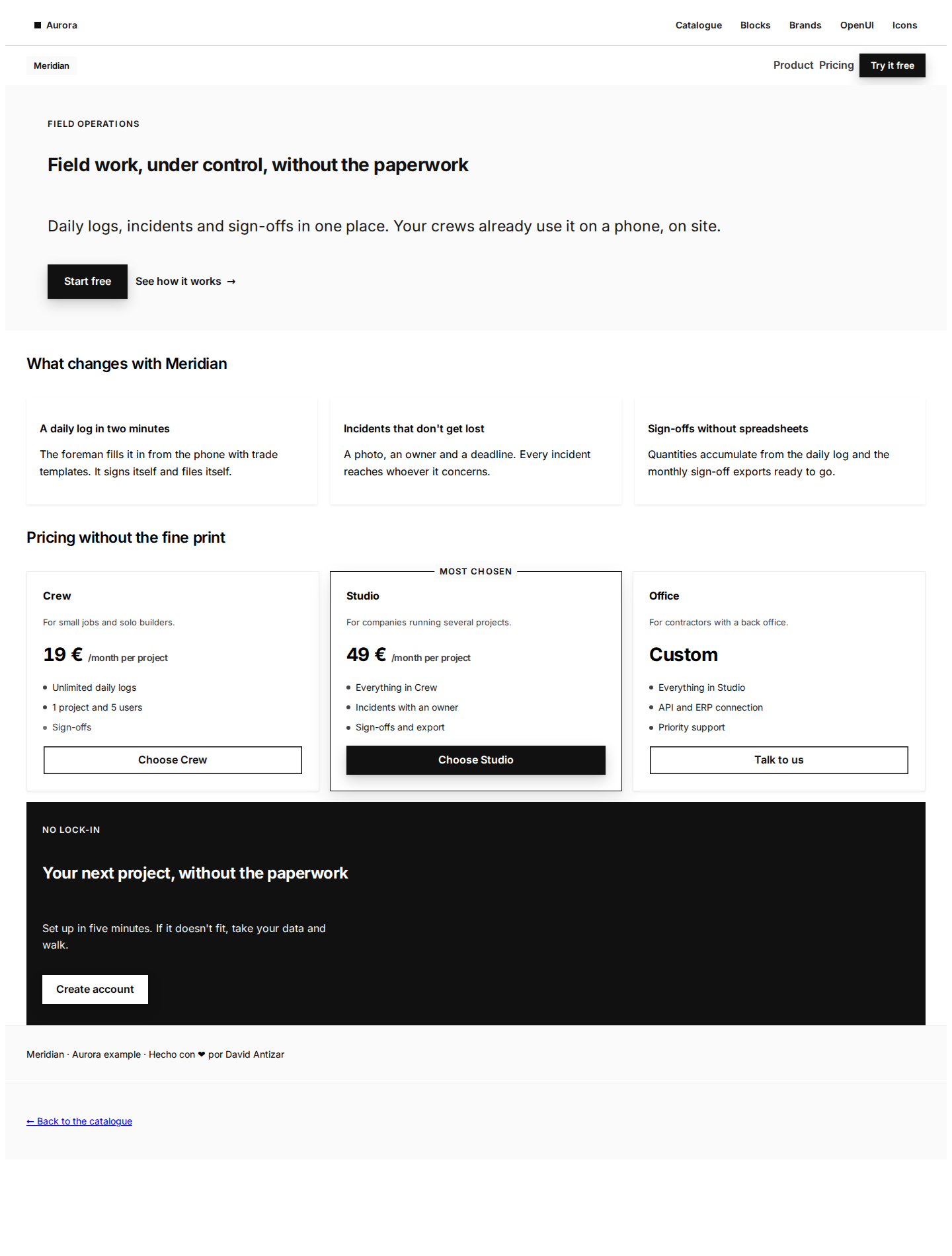
Landing page built with Aurora: hero, three cards, pricing
Landing
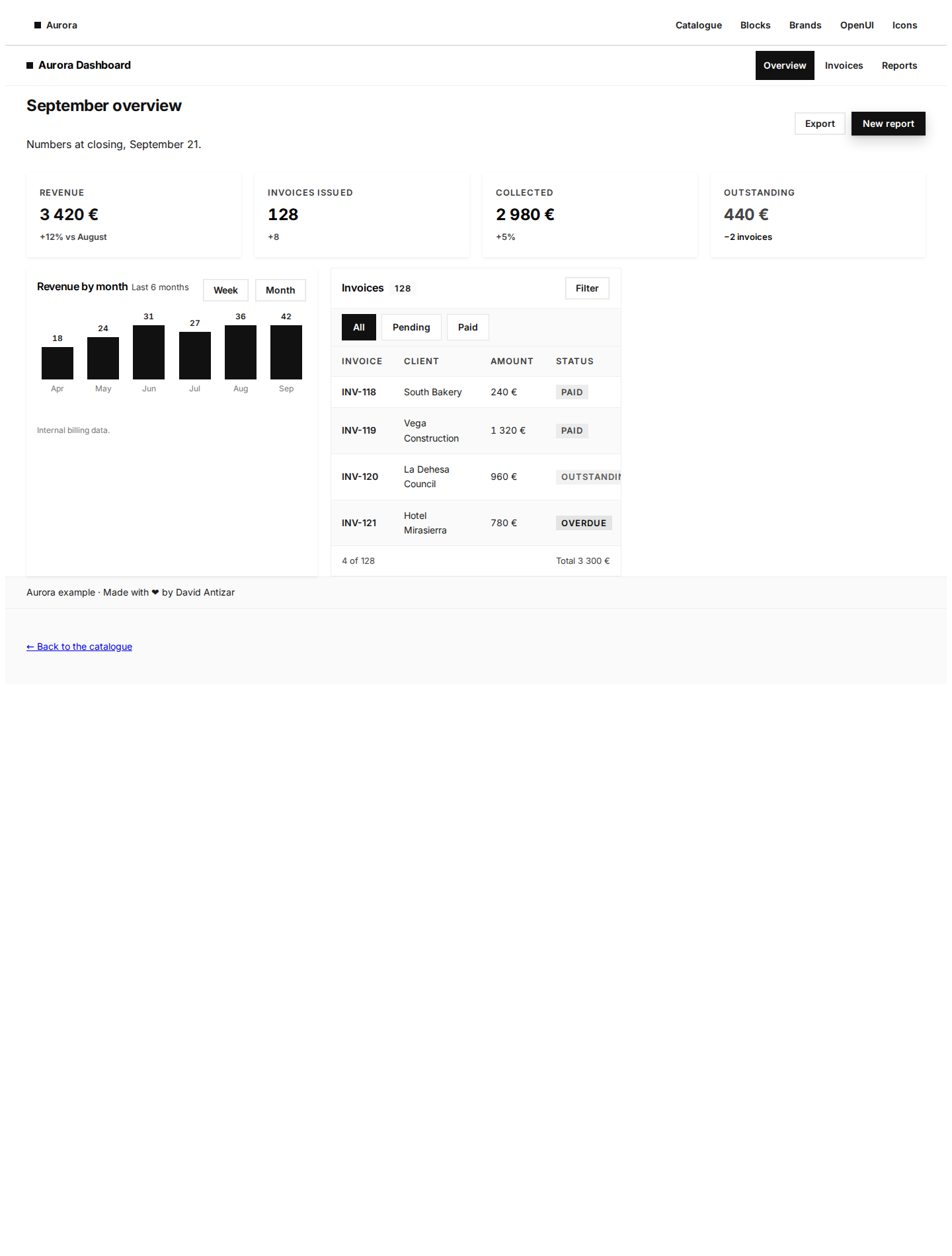
Dashboard built with Aurora: KPIs, table and chart
Dashboard

Not mock-ups. These are the design system's canonical examples, rendered by headless Chrome. The demo/ folder ships them as-is.

Built with Hermes

An agent that doesn't guess

Install both, or read the code: four SKILL.md files and 240 lines of Python with no dependencies.